

It's not the things themselves that are difficult to part with – it's the memories attached to them.
If you've ever opened a box in the loft intending to have a quick sort, only to find yourself sitting on the floor an hour later smiling, laughing or even crying over old letters, children's drawings or holiday souvenirs, you're certainly not alone.
When I work with clients, one of the biggest challenges isn't deciding whether to keep a broken kitchen gadget or an unworn jumper. It's the sentimental belongings.
These are the items that represent people we love, places we've been and chapters of our lives that we never want to forget. They can hold happiness, grief, pride, regret, nostalgia and hope. It's no wonder they can feel almost impossible to declutter.
The important thing to remember is this: decluttering sentimental items isn't about getting rid of your memories. It's about deciding how you want to keep them.
Why sentimental belongings are so difficult
Every object tells a story.
A concert ticket might remind you of your first date with your partner.
A child's tiny pair of shoes takes you straight back to those first wobbly steps.
A souvenir picked up on holiday brings back the smell of the sea, the warmth of the sunshine and the excitement of discovering somewhere new.
The item becomes a shortcut to a memory, and our brains naturally worry that if the object disappears, the memory might disappear too.
In reality, the memory usually lives on even when the object doesn't.
A memory box: keeping the story, not the clutter
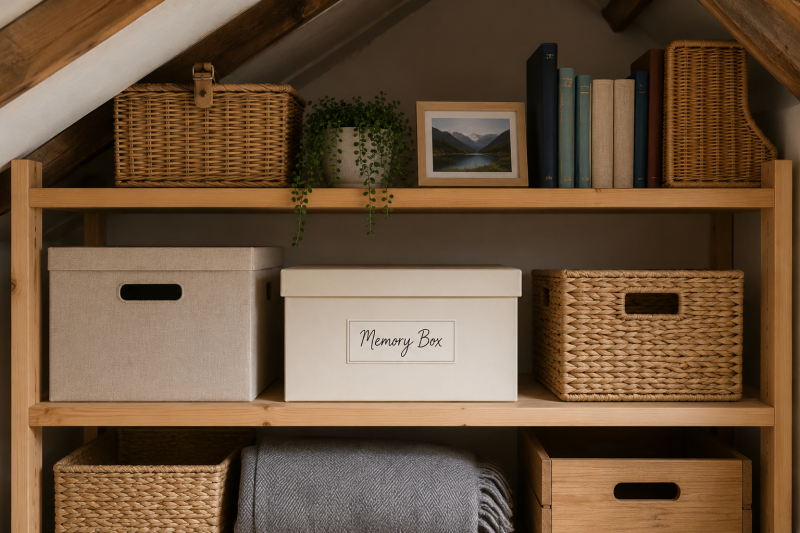
One of my favourite ways to preserve sentimental items is by creating a memory box.
A memory box is simply a carefully chosen container where you keep a small collection of your most meaningful keepsakes. Rather than storing everything, you choose the items that truly represent your story.
Mine contains:
- Handwritten letters from my younger days and a few special postcards (maybe I'll print out some emails or messages as well)
- A handful of photographs that have special memories
- A small selection of my children's' most notable artwork and a special item each have made for me
- A favourite family recipe written in a loved one's handwriting
- Awards or certificates that mean something to me
- A few objects that represent something significant that shaped me
- A handful of objects from my travelling days
The beauty of a memory box is that every item has earned its place. Instead of feeling overwhelmed by several boxes in the loft, or items dotted around your house, you have one meaningful collection that you take out at any time and can enjoy the memories, and the best thing is they're all kept in the same place.
The story matters more than the object
Sometimes the real treasure isn't the item - it's the story behind it.
If you're worried that future generations won't understand why something mattered to you, consider writing a short note.
- Who gave it to you?
- Where were you?
- Why did it make you smile?
- What happened that day?
A simple handwritten note can transform an ordinary object into a family treasure. Even if nobody else keeps the item forever, they'll know the story behind it.

A personal story
Having spent several years living and working abroad, I was incredibly fortunate to travel to many fascinating places. Like many people, I collected everything:
- Train tickets
- Boarding passes
- Museum leaflets
- Maps
- Ticket stubs
- Brochures
My plan was always the same.
"I'll make a beautiful scrapbook someday."
Someday never arrived.
Instead, those papers have sat in a box in the attic for over seven years.
Recently, I decided it was time to go through them properly. I realised something that surprised me. Although those ticket stubs brought back wonderful memories for me, they probably wouldn't mean very much to my children and grandchildren when I'm no longer here. Without me to tell the stories, they'd simply be pieces of paper. So instead of feeling guilty about the scrapbook I never made, I made a different choice ...
I spent a lovely evening looking through everything, smiling at memories I'd almost forgotten. I picked out just a handful of the tickets and keepsakes that instantly took me back to special moments, wrote the memory they evoke on a sticky note attached to them, placed them in an envelope and added the envelope to my memory box.
The rest went into the recycling.
And do you know what?
I didn't lose those memories.
If anything, I appreciated them even more.
I still have my photo books, which tell the story of my travels far better than hundreds of old leaflets ever could. Best of all, there's now one less box taking up space in my attic.
That experience reminded me that preserving memories doesn't have to mean preserving every single piece of paper or item.
Five tips for decluttering sentimental belongings
1. Leave sentimental items until last
They're often the hardest category to tackle. Build your decluttering confidence by making decisions on easier items first.
2. Keep the best, not everything
Choose the items that instantly make you smile or tell an important story. One meaningful keepsake is often worth more than twenty that barely stir a memory.
3. Create a memory box
Give yourself permission to keep your favourites; however, set a limit. Knowing your memory box has a fixed size helps you choose what really matters, so when it is full you have to think carefully about what can be let go of to fit the new sentimental item in.
4. Tell the story
Write a short note about why an item is special. Future generations are often far more interested in your memories than in the object itself.
5. Remember that memories live in you
Objects can remind us of precious moments, but they don't own those memories. Letting go of an item doesn't mean letting go of the people, places or experiences that shaped your life.

Be kind to yourself
There is no prize for decluttering the fastest: some sentimental items need time.
It's perfectly okay to laugh, cry, pause for a cup of tea or decide you're not ready just yet.
Decluttering isn't about living with as little as possible: it's about making space for the things that matter most.
And sometimes, by letting go of the things that matter a little less, we allow the truly precious memories to shine even brighter.
If you're finding sentimental belongings particularly difficult to tackle, remember that you don't have to do it alone. Having a calm, supportive person alongside you can make those emotional decisions feel much less overwhelming. At A New Dawn Organising, I understand that every item has a story, and together we can find a way to honour those memories while creating a home that feels lighter, calmer and easier to enjoy.
Add comment
Comments